 ultimate-guide
Driving Safety Tips for New Drivers: 7 Essential Skills
Table of Contents
- Driving Safety Tips for New Drivers: Where to Start
- Defensive Driving Techniques for Beginners
- Master Mirror Adjustment and Blind Spot Awareness
- Common Driving Test Mistakes to Avoid
- Vehicle Control, Braking Distance, and Reaction Time
- Affordable Driving Lessons in Orange County
- Building Confidence for the Road Ahead
- Frequently Asked Questions
Last Updated: September 18, 2026
Driving Safety Tips for New Drivers: Where to Start
Learning to drive safely is one of the most important skills you'll develop. Understanding fundamental driving safety tips for new drivers can mean the difference between a smooth journey and a dangerous mistake.
Driving safety isn't complicated. It's about mastering a few core techniques, building awareness of your surroundings, and practicing consistently until those habits become automatic.
This guide covers essential skills that form the foundation of safe driving: defensive driving techniques, mirror awareness, common test mistakes, vehicle control fundamentals, and building genuine confidence on the road.
Defensive Driving Techniques for Beginners
Defensive driving means driving as if everyone around you might make a mistake, because they will.
Anticipate hazards before they happen. Scan the road 10-15 seconds ahead, watch for brake lights in the distance, notice which cars are drifting between lanes, and identify potential escape routes if something goes wrong.
Here's what defensive driving looks like in practice:
- Maintain safe following distance. Stay at least three seconds behind the car ahead of you. In rain or fog, increase this to four or five seconds. This gives you reaction time if the driver brakes suddenly.
- Anticipate driver behavior. If a car is moving slowly in the left lane, expect it might merge into your lane without signaling. If someone's brake lights flicker on and off, they're probably distracted, give them extra space.
- Avoid distractions. Your phone, passengers, and the radio are all competing for your attention. New drivers especially need full focus. Put your phone in the trunk during drives.
- Adjust speed for conditions. Obeying speed limits is the baseline, but safe driving means slowing down in rain, fog, heavy traffic, or unfamiliar areas. Speed limits assume ideal conditions.
- Never assume right of way. Even if you have the green light, glance left and right before entering an intersection. Drivers run red lights constantly.
A common mistake is overconfidence after a few good drives. The safest drivers treat every drive like they're being tested.
Master Mirror Adjustment and Blind Spot Awareness
Most new drivers adjust their mirrors once and never touch them again. Properly positioned mirrors eliminate blind spots, the areas you cannot see even when turning your head.
Before you drive anywhere, spend two minutes setting up your mirrors correctly:
Rearview mirror: Position it so you can see the entire rear window with just a slight head turn. The horizon should be in the middle of the mirror.
Left side mirror: Lean your head toward the left window. Adjust the mirror so you can just barely see the left side of your car on the right edge of the mirror. Your car should take up about one-quarter of the mirror's view.
Right side mirror: Lean toward the center of the car. Adjust so you can just barely see the right side of your car on the left edge of the mirror.
Once set, these mirrors create almost zero blind spots. The key is that you should see very little of your own car, mostly road and surrounding traffic.
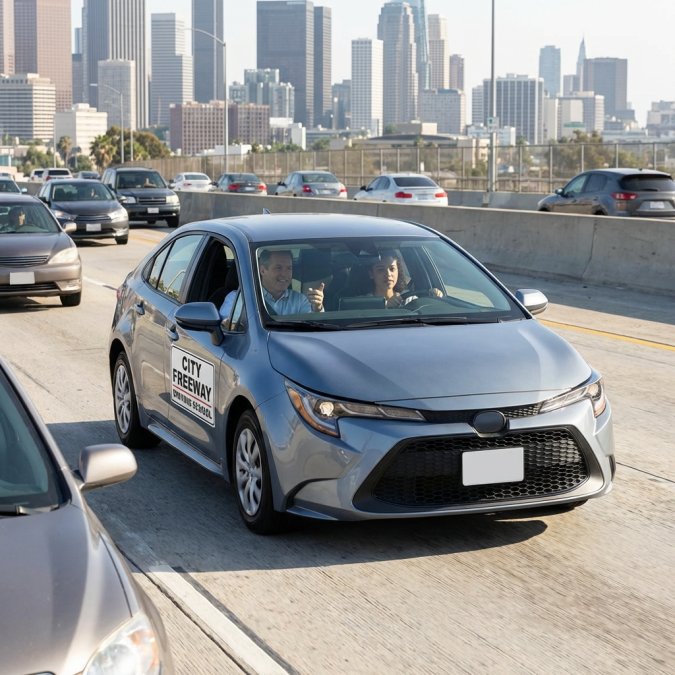
Even with perfect mirrors, blind spots still exist. Before changing lanes, always perform a shoulder check, turn your head to look over your shoulder. This catches vehicles mirrors can't reach.
When merging onto highways or changing lanes in traffic, the sequence is: signal, check mirrors, shoulder check, then move. If you skip any step, you're gambling.
Common Driving Test Mistakes to Avoid
Most test failures result from panic, careless mistakes, or decision-making breakdowns during the exam, not from not knowing the rules.
Mechanical mistakes examiners watch for:
Rolling stops. You must come to a complete stop at every stop sign, a full stop where the car is stationary for at least one second. Examiners watch for this constantly. Slow down your mental pace during the test.
Failing to signal early enough. Signal at least 100 feet before turning and hold it until you're halfway through the turn. Practice until it feels automatic.
Improper lane positioning. Stay centered in your lane. Practice staying in the middle during every drive so it becomes muscle memory.
Speeding or going too slowly. Match the posted speed limit exactly. Set your cruise control during practice drives to internalize the correct speed.
Jerky steering or braking. Smooth inputs demonstrate control. Practice gentle, gradual adjustments so they become automatic.
Not checking mirrors frequently. Glance at your mirrors every 5-10 seconds. Examiners want to see that you're aware of traffic around you, not just in front. Make mirror checks visible, obvious head movements, so the examiner sees you doing it.
Hesitation at intersections. If you have the right of way, proceed with confidence. Know when you have right of way and use it.
The psychological dimension: test anxiety and performance under pressure
Even skilled drivers sometimes fail the test because of anxiety. Test anxiety is a predictable physiological response to high-stakes evaluation that you can manage.
Why test anxiety happens. Your nervous system perceives the test as a threat, triggering elevated heart rate, tunnel vision, and slower processing speed. This is why you might execute a perfect three-point turn in practice but freeze during the test.
Pre-test mental preparation. Review the route if possible and visualize executing each maneuver smoothly. Get adequate sleep, avoid caffeine, and arrive 15 minutes early.
During the test: managing in-the-moment anxiety. If panic rises, use the grounding technique: notice five things you can see, four you can hear, three you can feel. If unsure, ask for clarification rather than guessing.
The role of professional instruction. DMV test preparation with City Freeway Driving School familiarizes you with what examiners look for and what the test route typically includes. Our lesson packages across Irvine, Orange, Santa Ana, Tustin, Costa Mesa, Anaheim, and many other Orange County communities are designed to build both skill and test-day confidence. With our flexible seven-day-a-week schedule, you can fit test preparation into your life without stress.
The day-of mindset. The examiner wants you to pass and is assessing whether you can safely operate a vehicle. Shift from "I have to be perfect" to "I have to demonstrate basic competence."
The best preparation for the test is consistent practice with honest feedback, combined with psychological tools for managing test-day stress. With both elements in place, you'll walk into the test confident and ready.
Vehicle Control, Braking Distance, and Reaction Time
Understanding how your car accelerates, stops, and corners is fundamental to safe driving.
Braking distance is the space your car needs to stop from the moment you press the brake. At 30 mph, your car needs roughly 65 feet; at 60 mph, it needs 180 feet. Most new drivers underestimate this, which is why tailgating is so dangerous.
Reaction time is roughly one second for an alert driver. At 60 mph, you travel 88 feet in that one second before your foot touches the brake. Add braking distance, and you need nearly 270 feet to stop safely from highway speed.
This is why following distance matters so much. Three seconds at highway speed means you're roughly 260 feet behind the car ahead, enough buffer to avoid most collisions if they brake suddenly.
Vehicle control during emergency maneuvers requires practice:
- Hard braking: Press firmly and steadily. Don't pump the brakes unless you have an older car without ABS. Modern cars handle hard braking better than gentle braking in emergencies.
- Steering in emergencies: If you must swerve, turn the wheel decisively but smoothly. Jerking the wheel can cause a skid.
- Recovering from skids: If your rear slides, steer in the direction the rear is sliding, not away from it. This is counterintuitive, which is why practice matters.
New drivers often freeze in emergencies because they haven't practiced. The solution is deliberate practice in safe environments, empty parking lots, quiet roads, so your muscle memory takes over when you're stressed.
Affordable Driving Lessons in Orange County
Building driving confidence takes practice, most effective with professional instruction. City Freeway Driving School provides affordable driving lessons across Orange County, including Irvine, Orange, Santa Ana, Tustin, Costa Mesa, Anaheim, and many other communities.
Professional instructors remain calm regardless of mistakes, identify exactly what you're doing wrong, and correct it immediately. They've seen every scenario and know how to guide you through situations that might panic an untrained supervisor.
Our flexible seven-day-a-week schedule with morning, afternoon, and evening availability fits your life. Our pricing makes professional training accessible, with various lesson packages depending on your needs. We also offer driving lessons on the freeway to build your confidence in high-speed traffic environments.
Beyond behind-the-wheel training, we provide Drivers Ed Online for Teens and DMV-compliant online driver education courses that cover traffic laws, road signs, and hazard recognition.
Building Confidence for the Road Ahead
Confidence comes from knowing you've prepared thoroughly, understand your emotional responses, and have concrete tools to manage anxiety.
Cognitive techniques for managing driving anxiety:
Frequently Asked Questions
What are the most important driving safety tips for new drivers?
Focus on these core areas: adjust mirrors and seating before driving, maintain proper following distance (at least 3 seconds behind other vehicles), avoid distractions like phones, obey speed limits and traffic signals, and stay alert to hazards. Defensive driving techniques, anticipating other drivers' actions and positioning your vehicle safely, form the foundation of safe driving. Practice these fundamentals consistently, and your confidence will grow with experience.
How can new drivers improve their defensive driving skills?
Defensive driving means staying aware of road conditions, other vehicles, and potential hazards before they become emergencies. Scan the road ahead and to the sides, check mirrors frequently, maintain safe braking distance, and reduce speed in poor conditions. Avoid aggressive maneuvers and stay calm in traffic. Professional driving lessons teach these techniques in real-world scenarios, helping you develop the hazard perception skills that separate safe drivers from careless ones.
What common driving test mistakes should I avoid?
New drivers often fail road tests by rolling through stop signs, failing to signal lane changes, not checking blind spots, speeding, and showing poor mirror discipline. Anxiety during the test can also hurt performance, examiners notice hesitation and jerky movements. Practice these specific maneuvers repeatedly before test day: smooth acceleration and braking, clear shoulder checks, proper signaling, and confident but cautious decision-making at intersections. Professional DMV test preparation focuses directly on these failure points.
Are affordable driving lessons available with flexible scheduling?
Yes. City Freeway Driving School offers driving lessons throughout Orange County, including Irvine, Orange, Santa Ana, Tustin, Costa Mesa, Anaheim, and many surrounding areas. We provide flexible scheduling seven days a week, including evenings and weekends, so lessons fit around school, work, or family commitments. Our DMV-compliant programs range from online driver education to behind-the-wheel training, designed to build your skills and confidence without breaking the budget.