 ultimate-guide
California Driving Laws for New Immigrants: 2026 Guide
Table of Contents
- What California Driving Laws Mean for New Immigrants
- AB 60 Driver's License Requirements Explained
- How to Get a Driver's License in Orange County
- DMV Behind-the-Wheel Driving Test Tips
- Insurance and Vehicle Registration for New Residents
- Affordable Driving Lessons in Orange County
- Language Resources and Support for Immigrant Drivers
- Conclusion
- Frequently Asked Questions
Last Updated: September 27, 2026
What California Driving Laws Mean for New Immigrants
California driving laws for new immigrants rest on one principle: you can drive legally here regardless of immigration status, as long as you meet the state's licensing requirements. This guide from City Freeway Driving School walks through what changed, what you need, and how to get licensed in Orange County without wasting a trip to the DMV.
Key Differences from Driving in Other Countries
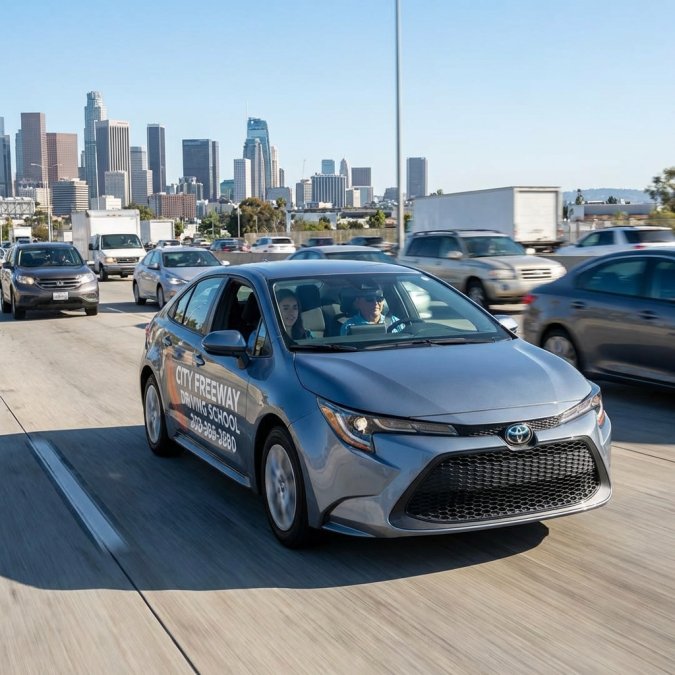
Traffic laws here are stricter about right-of-way than many newcomers expect. A four-way stop requires a full stop, not a rolling one, and the first vehicle to arrive goes first. Right turns on red are legal after a complete stop unless a sign prohibits it.
AB 60 Driver's License Requirements Explained
AB 60 driver's license requirements are straightforward on paper: you must be a California resident, pass the written knowledge test, pass a behind-the-wheel driving test, and provide proof of identity and residency. Immigration status is not part of the criteria. What trips people up is the document tier system, so treat this section as your checklist rather than a summary.
Who Qualifies Under AB 60
Any California resident who meets the standard licensing requirements qualifies, regardless of immigration status. You must be at least 16 for a provisional license or 18 for a standard one, and you cannot already hold a valid license from another state. A prior license from another country does not disqualify you, but the DMV will still require you to pass both the knowledge and driving tests here.
Documents You Need for an AB 60 Application
The DMV accepts a defined list of identity documents, and this is where applications stall. Common accepted items include:
- A valid foreign passport
- A consular identification card (for example, a Mexican matrícula consular)
- A certified birth certificate from your country of origin
- A marriage certificate or court document establishing name changes
- A foreign driver's license (accepted as a secondary identity document, not as proof you can skip testing)
What an AB 60 License Does and Does Not Do
An AB 60 license looks like a standard California driver's license but carries a federal-limitation notice on the front. That notice means the card cannot be used as federal identification, you cannot board a domestic flight with it or enter a federal building using it alone. It is still a fully valid license for driving, buying insurance, and registering a vehicle in California.
Fee Exemption and Appointment Notes
Applicants who can show they meet the state's low-income threshold may qualify for a fee exemption on the AB 60 application. Ask about this when you book your appointment, the DMV does not always volunteer it. Appointments fill quickly at busy offices, so book online as early as you can and arrive with your documents already sorted in the order the checklist lists them.
How This Connects to Your Driving Test
AB 60 changes the paperwork, not the driving standard. You still take the same knowledge test and the same behind-the-wheel test as any other applicant, and you still need supervised practice before test day. That is where professional instruction pays off, our instructors at City Freeway Driving School work with AB 60 applicants every week and know which documents and which driving habits tend to cause problems.
How to Get a Driver's License in Orange County
Getting a driver's license in Orange County follows the same state process as anywhere in California, but local DMV offices in Santa Ana, Costa Mesa, Fullerton, and Westminster serve the area. Here's the sequence:
- Study the California Driver's Handbook and take the written knowledge test
- Complete any required driver education or behind-the-wheel training
- Gather your identity and residency documents
- Schedule a DMV appointment online to avoid walk-in waits
- Pass the vision screening and knowledge test
- Pass the behind-the-wheel driving test
- Receive your license by mail
DMV Behind-the-Wheel Driving Test Tips
The behind-the-wheel test lasts roughly 20 minutes and grades you on observation, control, and judgment. Examiners aren't looking for perfection. They're looking for safe, predictable driving.
Common Pitfalls That Fail New Drivers
The most common failure is not checking mirrors and blind spots obviously enough. Examiners must see your head turn. Failing to signal before lane changes, rolling through stop signs, and driving too slowly out of nervousness also cost points.
Insurance and Vehicle Registration for New Residents
Most guides stop at the license. In practice, the two questions new immigrants ask us most are about insurance and registration, because you cannot legally drive in California without both, and the rules are different from what many newcomers expect.
Minimum Auto Insurance in California
California requires liability coverage as a condition of driving and of registering a vehicle. The state minimums are:
- Bodily injury liability: a set dollar amount per person injured in an accident you cause
- Bodily injury liability: a higher set dollar amount total per accident
- Property damage liability: a set dollar amount per accident
How to Get Insured as a New Immigrant
A common pattern is that insurers ask for a U.S. driver's license number, a Social Security number, or a prior U.S. insurance history. None of those are strictly required to buy a policy in California. What you will typically need:
- Your California driver's license or AB 60 license number, once issued
- The vehicle identification number (VIN) of the car you are insuring
- Proof of your California address
- A payment method
Registering a Vehicle in California
If you brought a car from another state or country, you generally have a short window after establishing residency to register it here. The sequence is:
- Get your California auto insurance in place first, you cannot register without it
- Complete a smog certification if the vehicle is of a model year that requires it
- Bring your out-of-state title or proof of purchase, your insurance card, and your residency documents to a DMV office
- Pay the registration fees and any use tax owed
- Receive your California plates and registration card
Why This Matters for New Drivers
Insurance and registration are the two follow-up steps that catch new immigrants off guard, and they are also the two steps where a small mistake, a lapsed policy, a missed registration deadline, an out-of-state plate that has expired, can turn into a license problem. Handling them in the right order, right after you get licensed, keeps you legal and keeps your record clean.
Affordable Driving Lessons in Orange County
Affordable driving lessons in Orange County don't have to mean compromised instruction. City Freeway Driving School offers competitive rates in the area while keeping every course DMV-compliant and taught by certified instructors.
| What You Need | How We Help | Best For |
|---|---|---|
| First license | DMV-approved 30-hour online driver education | Teens under 18 |
| Behind-the-wheel hours | 6, 10, or 16-hour training packages | All new drivers |
| Test preparation | Practice routes matching local DMV offices | Nervous test-takers |
| Freeway confidence | Highway and merging instruction | Rusty or returning drivers |
Language Resources and Support for Immigrant Drivers
The California DMV offers the driver's handbook and knowledge test in multiple languages, which removes a major hurdle for non-native English speakers. Ask about interpreter options when you schedule your appointment.
Conclusion
The licensing process rewards preparation, and the drivers who struggle most are the ones who treat the test as a formality. City Freeway Driving School prepares you with DMV-compliant courses, certified instructors, and practice on the same routes you'll face on test day.
Frequently Asked Questions
Can new immigrants get a driver's license without a social security number?
Yes. California's AB 60 law allows residents who cannot provide proof of legal presence to apply for a driver's license using alternative documents. You will need to prove your identity with a passport or consular identification card and prove California residency with documents like utility bills or rental agreements. A social security number is not required, but you must still pass the written knowledge test and behind-the-wheel driving test.
What is an AB 60 driver's license and how is it different?
An AB 60 license is a California driver's license issued to residents who cannot provide proof of legal presence. It looks similar to a standard license but carries a notice on the back stating it is not acceptable for federal identification purposes. It grants full driving privileges and is valid for the same road use as any other California non-commercial license.
Do I need to take a driving test if I have a license from another country?
In most cases, yes. California does not have reciprocal license exchange agreements with most countries. You will typically need to pass the written knowledge test and the behind-the-wheel driving test. A foreign driver's license or international driving permit can sometimes be used to waive the behind-the-wheel portion if it meets specific DMV criteria, but you should verify your situation directly with the DMV.
How do I schedule behind-the-wheel training in Orange County?
You can book behind-the-wheel training directly through City Freeway Driving School. We offer flexible scheduling seven days a week, including evenings and weekends, to work around school and job commitments. Our instructors are familiar with local DMV offices in Santa Ana, Costa Mesa, Fullerton, and Westminster, so you practice on the same roads and conditions you will face during your test.
What documents are required for a DMV license application?
You will need proof of identity (passport, consular ID, or birth certificate), proof of California residency (utility bills, rental agreement, or school records), and your social security number if you have one. For AB 60 applications, alternative documents are accepted. Bring original documents, not photocopies, and arrive with a completed application form to save time at the DMV office.
Are there specific driving laws for new residents to follow?
Yes. New residents must obtain a California license within 10 days of establishing residency. California law requires all drivers to carry auto insurance, and the state has specific rules on cell phone use (hands-free only), child safety seats, and right-of-way at intersections. Studying the California Driver Handbook before your knowledge test helps you understand these rules and avoid costly mistakes on the road.