 how-to
How Do Beginners Merge Onto a Busy Freeway Safely?
Quick Summary
To handle merging onto freeways as a beginner, use the entrance ramp to build speed so you match traffic flow before reaching the merge point. Find a gap by watching the car behind the opening, then check mirrors and your blind spot before you commit. Keep your speed steady and signal early so other drivers can plan around you.
- Build speed gradually on the entrance ramp so you reach the merge point near freeway speed.
- Read the gap by the car trailing the opening, since it shows whether the space is growing or shrinking.
- Check mirrors, glance over your shoulder for your blind spot, then signal before moving.
- Avoid stopping at the end of the ramp, because it can surprise drivers behind you.
- If no safe gap appears, slow down, stay calm, and look for a safer moment rather than forcing it.
Table of Contents
- Why Merging Onto a Busy Freeway Feels So Hard
- Freeway Merging Tips for New Drivers
- Step 1: Use the Entrance Ramp to Build Speed
- Step 2: How to Find a Gap in Traffic When Merging
- Step 3: How to Check Blind Spots When Changing Lanes
- What to Do When You Can't Merge onto the Freeway
- Book Your Freeway Practice With City Freeway Driving School
- Frequently Asked Questions
Why Merging Onto a Busy Freeway Feels So Hard
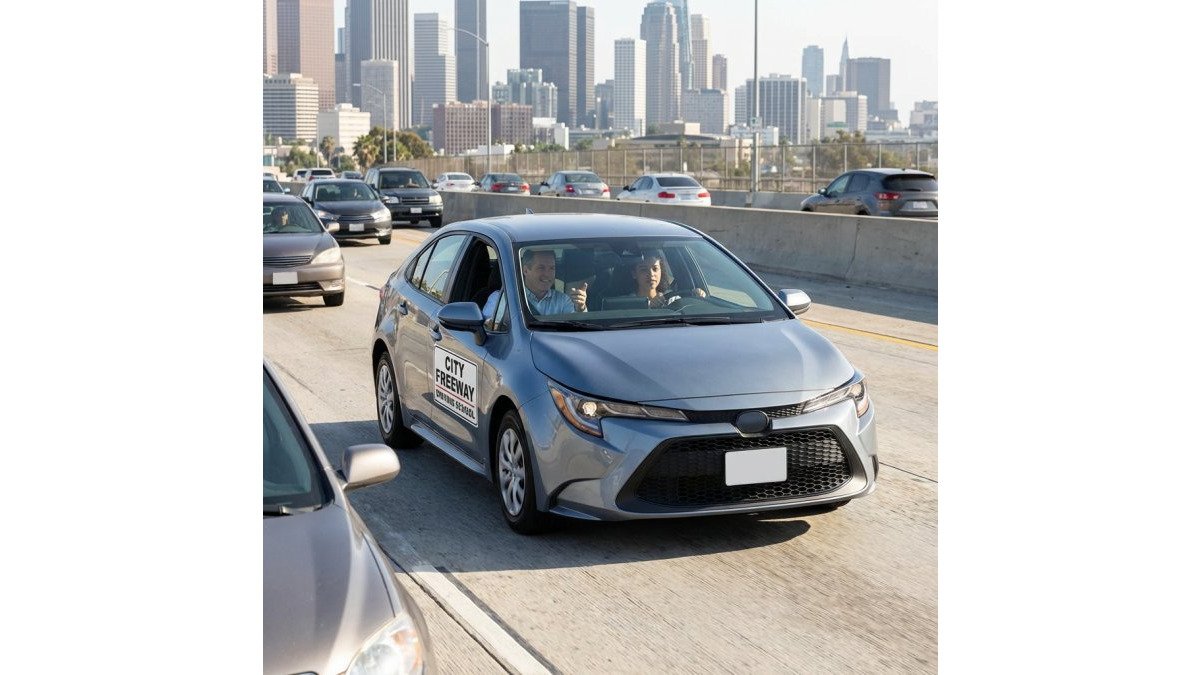
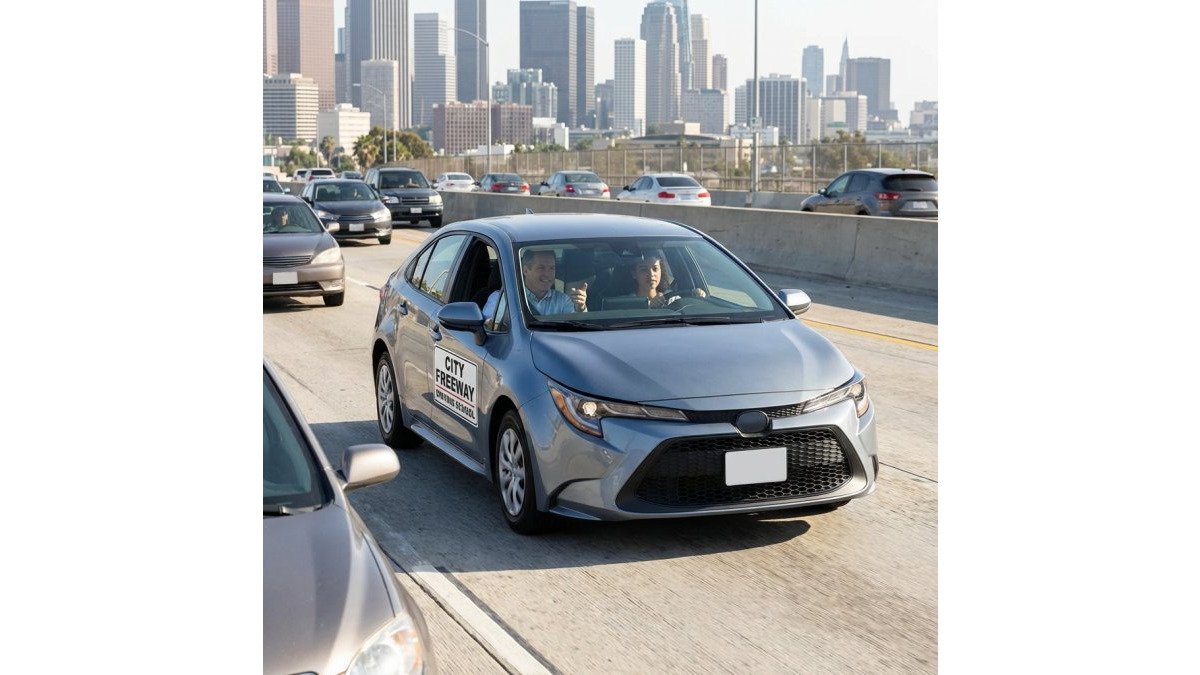
Merging onto freeways is one of the most stressful parts of learning to drive. You have a short ramp, fast traffic, and only a few seconds to decide. The good news is that the skill is learnable, and most beginners improve quickly with the right steps. At City Freeway Driving School in Tustin, we help new drivers in Orange County build this skill with calm, structured practice.
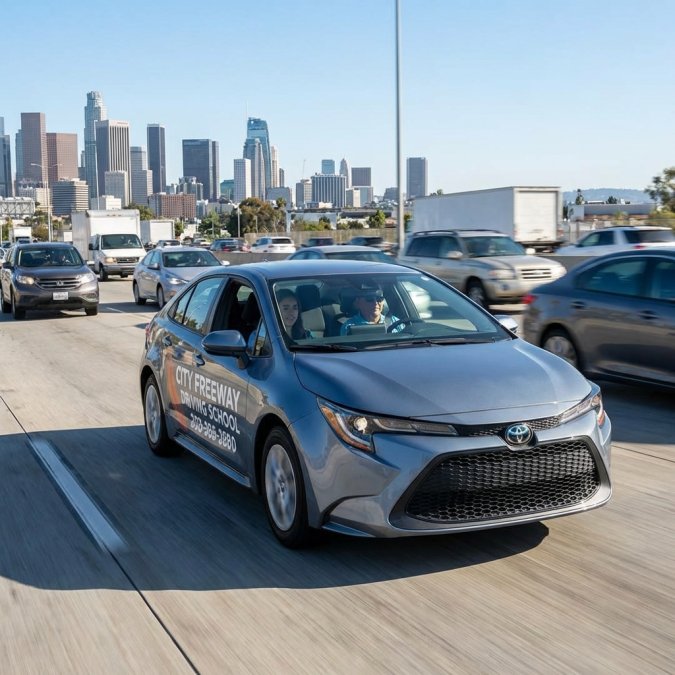
According to the Federal Highway Administration, merging, diverging, and weaving areas are major bottleneck locations on freeways and a significant source of recurring congestion Alternative Designs to Alleviate Freeway Bottlenecks at Merge. That means the spot where you join traffic is one of the busiest and most demanding places on the road.
Here's what makes it hard for beginners:
- You have to match the speed of fast-moving traffic.
- You have to judge gaps while also watching mirrors and signs.
- You often have a short ramp with little room to adjust.
Watch out: Many new drivers stop completely at the end of the ramp, which can surprise drivers behind them. Build enough speed on the ramp before you reach the merge point.
Freeway Merging Tips for New Drivers
Good merging comes down to three habits: speed, timing, and awareness. Practice each one before you try the busiest freeways.
- Plan your merge early, while you're still on the entrance ramp.
- Check your mirrors and your blind spot before you commit.
- Keep your hands steady and your eyes looking ahead, not at your feet.
- Signal your intent so other drivers can plan around you.
Do not assume other drivers will always make room for you. Some drivers will not slow down, so stay ready to adjust. A calm, predictable merge is safer than a fast, rushed one.
Step 1: Use the Entrance Ramp to Build Speed
The entrance ramp exists so you can match traffic speed before you merge. Use all of it. Many beginners wait too long to accelerate and arrive at the merge point too slow.
Build your speed gradually as you move along the ramp. Look ahead to where the lane ends and where traffic is moving. Your goal is to be moving at a speed close to the freeway flow by the time you reach the merge point.
Practice this on quieter ramps first. Repeat the same routine until the speed change feels natural. For a structured approach, see How to Practice Freeway Merging Safely.
Step 2: How to Find a Gap in Traffic When Merging
A gap is the space between two vehicles in the lane you want to enter. Finding a safe gap is the core of a good merge, and it is a skill you can break into steps rather than a reflex you either have or don't.
Read the gap by the car behind it, not the car beside it. The vehicle trailing the opening controls whether the gap is growing or shrinking. If that trailing car is closing on you quickly, the gap is disappearing even though it looks wide right now. If it is holding steady or falling back, the gap is real. Beginners tend to stare at the car they are trying to get in front of; the more useful information is behind it.
Judge closing speed, not just distance. A gap that is two car lengths at matching speed is workable. A gap that is four car lengths while the trailing car is gaining on you is a trap. On the ramp, compare your speed to the flow: if traffic is moving noticeably faster than you are, you need a larger opening because you will still be accelerating into it.
Use the whole ramp to shop for the gap. While you are still building speed, scan the freeway lane you intend to enter and pick a target opening early, ideally one that will reach you as the ramp ends, not one that is already beside you. Then keep your eyes moving between that target and the lane ahead so you are not surprised by a slowdown.
Match speed first, then steer. The most common beginner error is aiming the car at a gap before the speeds match. Get your speed close to the flow, confirm the gap is still opening, and only then commit the steering input. A merge where speed is matched needs only a gentle movement; a merge where speed is mismatched needs a lunge, and lunges are where things go wrong.
When the ramp is short or crowded, you have less time to shop, so start the scan earlier, while you are still on the ramp's straight section, and accept a smaller but stable gap over a larger but closing one. If traffic is dense and no stable gap appears, do not force it: ease off the accelerator, keep your signal on, and let the merge point come to you rather than racing a shrinking opening.
Watch out: Do not fixate on one gap. If the trailing car closes it, you need a backup opening already identified, and staring at the lost gap costs you the seconds you need to find the next one.
For more on gap selection and ramp speed, read Highway Entrance Merging for Confident Drivers.
Step 3: How to Check Blind Spots When Changing Lanes
Merging often requires a lane change, so blind spot checks matter. Your mirrors show most of what is around you, but the blind spot is the area they cannot cover, roughly the zone just off your rear quarter, where a car can sit unseen. Before you move over, turn your head and look over your shoulder.
Set the mirrors so the blind spot is small. Adjust your side mirrors outward until you can just barely see the side of your own car, or not at all. This widens the view beside you and shrinks the hidden zone. Do this while parked, not in traffic.
Run the check in a fixed order so it becomes automatic:
- Check the rearview mirror for the big picture behind you.
- Check the side mirror on the lane you are entering.
- Glance over your shoulder into the blind spot, a quick look, not a stare.
- Signal, then move smoothly only after the shoulder glance confirms the space is clear.
Keep the shoulder glance short. The point of the glance is to confirm what the mirror already suggested, not to study the lane. A glance that lasts too long takes your eyes off the road ahead, which is its own hazard at freeway speed. Confirm, then look forward again.
Do not let the car drift during the check. Beginners often steer slightly toward the lane they are checking. Keep a light, steady grip and hold your lane position until the signal and the glance are both done.
Signal before you need the space, not as you take it. A signal gives the driver beside you time to react. Signaling at the same moment you move gives them no warning and turns a routine lane change into a surprise.
Sequence matters more than speed. Mirror, mirror, shoulder, signal, move, in that order, every time. Rushing the order is how a driver ends up moving into a space that was never confirmed.
Watch out: A shoulder check that happens after you have already begun to steer is not a check, it is a reaction. Confirm the space first, then commit.
Repeat this routine every time you change lanes until it becomes automatic. For a full lane change routine tailored to new drivers in the area, see Lane Change Safety for New California Drivers.
What to Do When You Can't Merge onto the Freeway
Sometimes no safe gap appears. That's normal, and it's not a failure. If the ramp is ending and you don't see a safe opening, you can slow down and look for a longer on-ramp or a safer moment. Use your signal, stay calm, and avoid stopping in the travel lane if you can help it.
Many new drivers feel anxious after a difficult merge. Take a breath, go back to the basics, and practice again on a less busy road. Confidence grows with repetition. For structured practice that rebuilds freeway skills step by step, see Freeway Skills Improvement for Safer California Driving.
Book Your Freeway Practice With City Freeway Driving School
Freeway merging gets easier with guided practice, and the right instructor makes a big difference. You can learn about local Orange County behind-the-wheel training with City Freeway Driving School. City Freeway Driving School offers driving lessons across Orange County. Our schedule is flexible, with lessons available on weekends and evenings.
Our affordable pricing is designed to fit your budget. For current prices and a quote, contact City Freeway Driving School or visit our website.
Driving Lessons in Orange County for Teens and Adults. We are City Freeway Driving School in Tustin, serving most cities in Orange County, CA. For questions about our services, call our office at 714-734-9030 or visit our website.
Frequently Asked Questions
How do beginners merge onto a busy freeway?
Beginners should use the entrance ramp to match the speed of traffic before reaching the merge point. Signal early, check mirrors and the blind spot, then look for a gap in the flow of traffic. Enter smoothly once the gap is clear. Practicing on quieter freeways with an instructor beside you builds the timing and confidence needed for heavier traffic. City Freeway Driving School offers freeway driving lessons across Orange County, with appointments available seven days a week.
How fast should you drive when merging onto a freeway?
Aim to reach roughly the speed of the freeway traffic by the end of the entrance ramp. Merging too slowly forces other drivers to brake or swerve, while merging much faster than traffic makes it harder to find a safe gap. Use the full length of the ramp to accelerate. Your instructor can show you how the right speed feels during behind-the-wheel practice.
What should you do if there is no room to merge?
If no safe gap appears, do not force your way in. Keep your speed steady on the ramp, signal your intent, and prepare to stop at the end of the ramp if necessary and only when it is safe to do so. Never stop on the shoulder unless there is an emergency. Practicing this scenario with an instructor helps you stay calm when it happens on a real road.
Ready to build your merging confidence? Contact City Freeway Driving School today to start your freeway practice.