 how-to
Freeway Driving Lessons for Beginners: A 2026 Guide
Table of Contents
- What to Expect in Your First Freeway Driving Lesson
- Behind the Wheel Training for Teens: Building Confidence on the Highway
- How to Merge Onto a Freeway Safely: Step-by-Step Technique
- Essential Highway Skills Every Beginner Must Master
- Psychological Preparation for Highway Anxiety
- Affordable Driving Lessons in Orange County with Flexible Schedules
- Preparing for Your DMV Road Test: What Examiners Look For
- Common Mistakes to Avoid During Freeway Driving
- Frequently Asked Questions
Last Updated: September 25, 2026
What to Expect in Your First Freeway Driving Lesson
Freeway driving lessons for beginners are both exciting and nerve-wracking, and your first one sets the tone for your confidence. You'll spend time in a dual-brake vehicle with a certified instructor who understands exactly what you're feeling. Most students are surprised by how manageable the experience becomes once they understand what's actually happening around them.
During your initial session, your instructor will start on local roads to assess your comfort level and basic vehicle control. Then you'll transition to the freeway during a quieter traffic window, typically mid-morning or early afternoon. Your instructor sits beside you with their own brake pedal, ready to help if needed. The goal isn't perfection on day one. It's building familiarity with speed, merging, and traffic flow in a controlled environment.
City Freeway Driving School structures these lessons to match your pace. Some students need one session to gain confidence. Others benefit from multiple lessons before attempting the freeway alone. There's no rush, and there's no judgment. Your instructor has guided hundreds of students through this exact moment.
Behind the Wheel Training for Teens: Building Confidence on the Highway
Behind the wheel training for teens is fundamentally different from classroom instruction. You can read about merging all you want, but your body needs to experience it, and your brain needs to process that experience with guidance from someone calm and experienced.
Teenagers often carry anxiety about highway driving. That anxiety is normal and actually protective. It keeps you alert. The job of behind the wheel training is to channel that alertness into smart decision-making rather than panic. Your instructor will teach you to scan the road systematically, anticipate other drivers' moves, and understand the physics of your vehicle at highway speeds.
The best behind the wheel training for teens includes real repetition. You'll practice merging multiple times in different traffic conditions. You'll experience what a sudden lane change by another driver feels like, and how to respond. You'll learn the rhythm of highway driving, when traffic is predictable and when it's not.
City Freeway Driving School offers structured behind the wheel training for teens that builds these skills progressively. Early sessions focus on fundamental techniques. Later sessions introduce more complex traffic scenarios. By the time you test for your license, highway driving feels familiar rather than foreign.
How to Merge Onto a Freeway Safely: Step-by-Step Technique
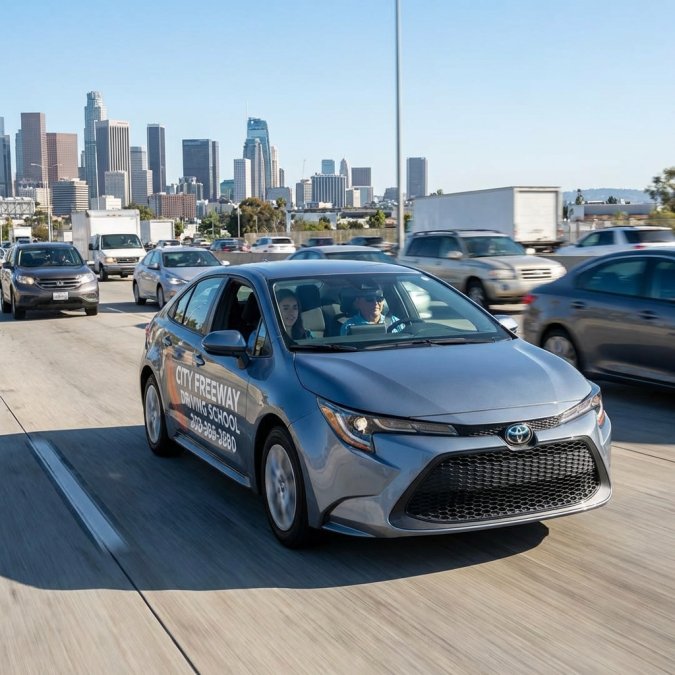
Merging is the single most important skill for freeway driving. It's where most beginner anxiety concentrates, and it's also where solid technique makes the biggest difference in your confidence and safety.
Acceleration Lane Strategy
The acceleration lane is your staging area. You're not supposed to merge immediately. Instead, you use this space to match the speed of freeway traffic. Most beginners make the mistake of accelerating too slowly or too quickly. The target is smooth, steady acceleration that gets you close to the speed of the traffic you're joining.
Look ahead into the freeway traffic. Identify a gap between vehicles where you can safely enter. A safe gap is typically at least 4-5 car lengths. As you accelerate through the acceleration lane, keep checking your mirrors and blind spots. Your speed should be close to the freeway speed by the time you reach the end of the acceleration lane.
Mirror Checks and Blind Spot Monitoring
Before you even think about moving into the freeway, you need to know what's around you. Check your rearview mirror. Check both side mirrors. Then, critically, turn your head and check your blind spot. That blind spot is the area your mirrors can't see, usually just behind and slightly to the side of your vehicle.
This sequence takes about three seconds. It becomes automatic after you practice it a few times. The reason it matters: a car in your blind spot won't show up in your mirrors. You have to physically look. Many freeway accidents happen because a driver didn't check that final blind spot before changing lanes.
Once you've confirmed the gap is clear, signal your intention to merge. Give other drivers a clear warning. Then smoothly steer into the freeway lane, maintaining your speed. The merge should feel controlled, not abrupt.
Essential Highway Skills Every Beginner Must Master
Highway driving requires skills beyond basic vehicle control. You're managing speed, distance, lane position, and awareness of multiple vehicles simultaneously. These skills develop with practice, but they follow clear principles.
Lane Changing Safety Protocols
Lane changing on the freeway is different from changing lanes on a city street. You're moving faster, other vehicles are moving faster, and the consequences of mistakes are higher. Lane changing safety protocols are straightforward but require discipline.
First, identify why you're changing lanes. Are you passing a slower vehicle? Exiting soon? Moving away from aggressive traffic? Have a reason. Don't change lanes randomly or out of habit.
Second, signal early. Give other drivers at least three to four seconds of warning. This is longer than most people think, but it's the standard that prevents surprises.
Third, check mirrors and blind spots before moving. This is non-negotiable. After checking, move smoothly and decisively. Don't hesitate in the middle of the lane change.
Finally, after you've completed the lane change, maintain your new lane for a reasonable distance before changing again. Constant lane changes are a sign of impatience and create danger.
Highway Speed Management and Traffic Flow
Most freeway accidents aren't caused by speed alone, they're caused by speed mismatch. When your speed differs significantly from the traffic around you, you create conflict. You're either blocking faster vehicles or weaving through slower ones.
The goal is to match the traffic flow. On most freeways, this means driving between 55 and 70 miles per hour, depending on conditions, posted limits, and the actual speed of surrounding traffic. If everyone around you is going 65, going 50 creates a hazard. If everyone is going 55, going 75 creates a hazard.
Speed management also means adjusting for conditions. Rain, fog, and heavy traffic all require slower speeds.
Safe Following Distance and Hazard Perception
The space between your vehicle and the one ahead is your safety buffer. Many beginners follow too closely, leaving no room to react if the car ahead brakes suddenly. The standard recommendation is the three-second rule: pick a fixed point on the road ahead. When the car in front passes that point, start counting. You should reach that point no sooner than three seconds later.
Psychological Preparation for Highway Anxiety
Highway anxiety is real, and it's more common than you might think. Even experienced drivers sometimes feel tension on the freeway. The difference is that experienced drivers have learned to manage that tension productively.
Affordable Driving Lessons in Orange County with Flexible Schedules
Finding quality freeway driving lessons shouldn't require juggling your entire schedule or straining your budget. City Freeway Driving School offers driving lessons throughout Orange County with scheduling flexibility that actually works for real life.
Training Packages and Flexible Driving School Schedules
City Freeway Driving School provides driving lessons designed around your availability. We operate seven days a week with flexible scheduling that includes evenings and weekends, so whether you have school until 4 PM, work irregular hours, or need weekend availability, we accommodate your life. We understand that teenagers have school and sports. Adults have work and family commitments. Our scheduling works with these realities.
Service Areas Across Orange County
We provide driving lessons in the freeway in Irvine, Orange, Santa Ana, Tustin, Costa Mesa, Anaheim, and many more cities in Orange County, California. Whether you're in a coastal community or inland, we have instructors familiar with your local freeways and DMV testing locations, including Santa Ana, Costa Mesa, Fullerton, and Westminster.
Preparing for Your DMV Road Test: What Examiners Look For
Your DMV road test is the checkpoint that determines whether you drive independently. Examiners aren't trying to trick you. They're assessing whether you can handle real-world freeway driving safely and legally. D.M.V test preparation with our instructors ensures you understand exactly what examiners are watching for.
Common Mistakes to Avoid During Freeway Driving
Most freeway mistakes fall into a few categories. Understanding these mistakes before you make them helps you avoid them.
Frequently Asked Questions
How long does it take to learn freeway driving as a beginner?
Most beginners need 6-10 hours of professional freeway driving lessons to develop basic competency with merging, lane changing, and speed management. However, the timeline depends on your prior driving experience, comfort level, and how frequently you practice. Some students feel confident after 6 hours; others benefit from 10-16 hours of behind-the-wheel training. Your instructor will assess your progress and recommend the right duration for your needs.
What is the best way to overcome anxiety about driving on the freeway?
Start with shorter freeway segments during off-peak hours, gradually building exposure to heavier traffic. Work with an instructor who understands highway phobia and can teach defensive driving techniques that give you real control. Practice controlled breathing and focus on one skill at a time, merging first, then lane changes, then speed management. Knowing that your instructor can use the dual-brake vehicle if needed provides a safety net that reduces anxiety significantly.
How do I prepare for my first freeway driving lesson?
Review California traffic laws and speed limits before your lesson. Ensure your vehicle is in good condition (tire pressure, mirrors adjusted, brakes functioning). Get a good night's sleep and eat a light meal beforehand. Arrive 10 minutes early to discuss your goals with your instructor. Wear comfortable clothing and shoes that allow good pedal control. Let your instructor know about any specific fears or past negative experiences so they can tailor the lesson to your needs.
Are freeway driving lessons different for teens versus adults?
Yes. Teen programs emphasize DMV-compliant behind-the-wheel training and meet state certification requirements for driver education. Adult lessons focus on skill gaps, confidence rebuilding, and adapting to local traffic patterns. Adults often need less foundational instruction but may require more psychological preparation if they've been off the road or have highway phobia. Both groups receive the same core highway skills, merging, lane changing, speed management, but the pacing and emphasis differ based on experience.